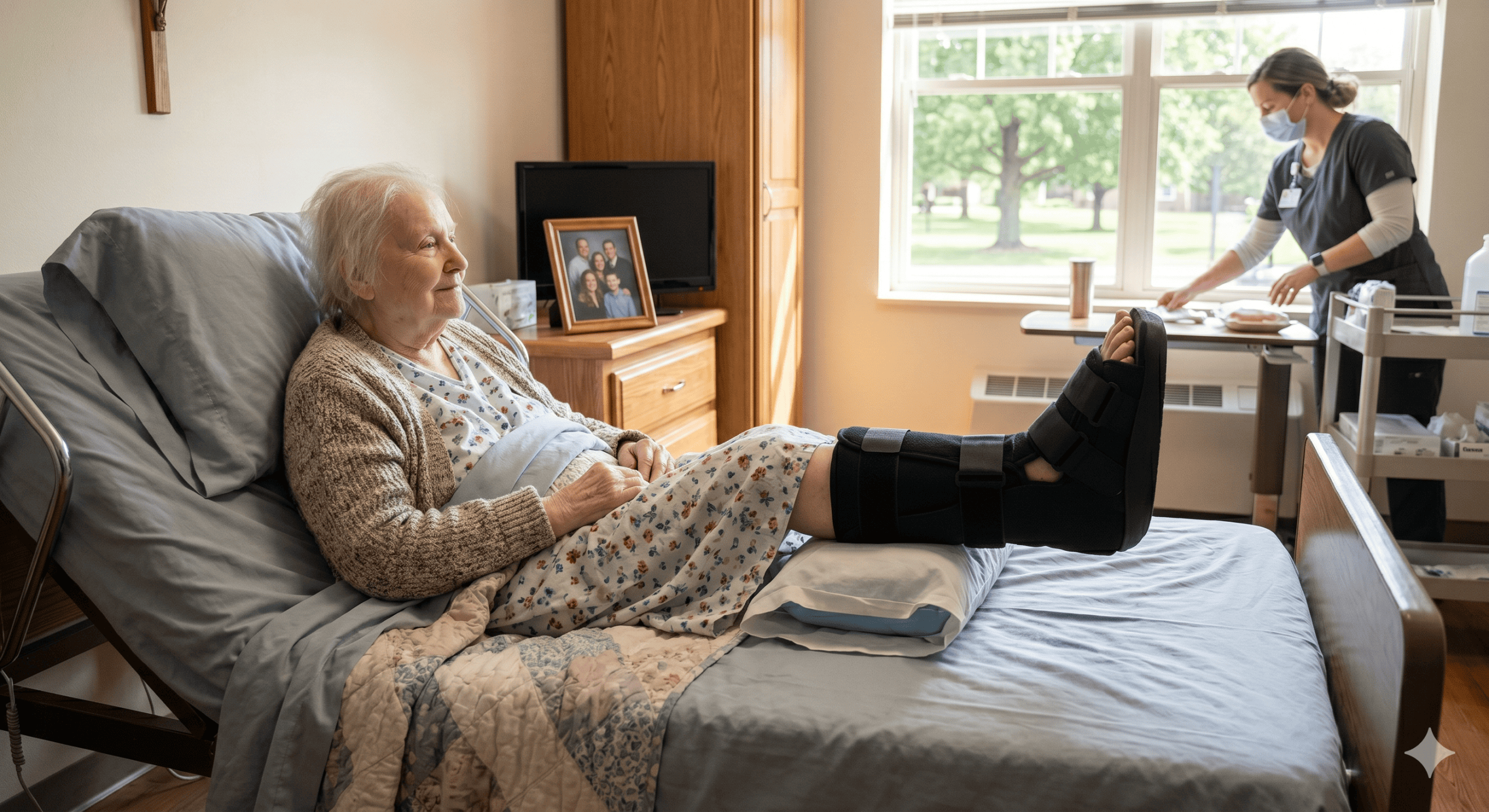
Heel Eschar & ‘Floating Feet’: Preventable Amputations
You entrusted an Indiana nursing home to provide the high standard of professional care your loved one deserves. Perhaps they were admitted to a facility for short-term physical rehabilitation following a minor fall, or maybe they require long-term custodial care due to advanced age, diabetes, or cognitive decline like Alzheimer’s. When you visit, you expect them to be clean, safe, and comfortable. But during a routine visit, you notice something deeply alarming: a thick, dark, crusty black scab has formed on your loved one’s heel.
When you discover a black scab on heel nursing home staff neglected to mention, you might be met with common industry platitudes. Administrators, wound nurses, and directors of nursing frequently dismiss these dark wounds as “just a normal part of getting older,” a natural side effect of poor circulation, or a sign that the body is simply “shutting down.”
These are excuses, not medical facts. In the world of long-term care litigation, a black scab on the heel is known as eschar. Far from being an inevitable consequence of aging, eschar represents a profound, systemic failure of basic nursing care—a silent, slow-moving medical disaster that routinely travels deep into the tissue until the heel bone becomes infected, leaving a surgeon with no choice but to perform a below-the-knee amputation (BKA).
For a comprehensive breakdown of your rights and what constitutes clinical negligence, read our guide on Indiana nursing home neglect explained. For families dealing with this devastating injury, partnering with an experienced Indiana nursing home neglect lawyer is the most powerful way to protect your loved one, expose clinical failures, and hold a negligent facility legally accountable.
1. The Pathology of Heel Eschar: A Deep-Tissue Disaster in Disguise
Nursing homes frequently try to hide behind complex medical jargon to mask their own failures. To understand why a heel ulcer is a sign of severe neglect, it is crucial to understand the unique anatomy of the human heel and how the body responds to prolonged, uninterrupted pressure.
Unlike other areas of the body, such as the buttocks or thighs, the heel is covered by an incredibly small volume of subcutaneous fat and muscle tissue. Because there is virtually no “padding” to protect it, mechanical loads and pressure from a mattress are transmitted directly onto the calcaneus (the heel bone).
When an immobile, sedated, or bedridden resident is left lying on their back (the supine position) without movement, the weight of the entire lower leg rests on a tiny surface area of the heel. The pressure exerted on these tissues easily exceeds the capillary closing pressure, which is the amount of pressure required to collapse the tiny blood vessels supplying oxygen to the skin (typically around 32 mmHg).
If you are wondering what is eschar on heel tissue and how it develops, the process is a direct result of tissue suffocation. When pressure remains completely unchecked, the heel undergoes a rapid series of pathological changes and deep-tissue injuries:
- Ischemia: Blood flow is severely restricted as localized mattress pressure exceeds the capillary closing threshold, starving tissues of oxygen.
- Deep Tissue Injury (DTI): The underlying subcutaneous fat and muscle decompose, leaving the overlying skin initially intact but deeply bruised and damaged from the inside out.
- Necrotic Eschar: The dead, dying tissue dehydrates and hardens into a thick, black, or dark brown leathery scab, rendering the wound “Unstageable.”
- Osteomyelitis: Pathogenic bacteria penetrate the deep, necrotic wound bed and directly infect the underlying calcaneus (heel bone).
In clinical terms, a pressure injury covered by eschar represents an unstageable heel pressure injury because the sheer thickness of the dead, black tissue completely blocks the clinician’s view. It is impossible to see how deep the destruction goes.
The tragedy of heel eschar is that facilities frequently ignore it because it is dry and intact. They view it as a “protective scab” and leave the resident’s feet resting heavily on the mattress, allowing the destructive pressure to continue unabated. Beneath that black scab, a silent chamber of bacteria breeds.
The progression from heel eschar osteomyelitis to a deep bone infection is rapid. Because diabetes and peripheral arterial disease restrict blood flow, the body’s immune cells cannot reach the foot to fight the infection. This clinical neglect results in a preventable amputation nursing home facilities could have easily avoided with basic preventative care.
2. The Golden Rule of Care: Who is the NPIAP and What is the ‘Floating Heels’ Protocol?
Heel pressure ulcers are preventable in virtually every clinical scenario. Understanding how to prevent heel pressure ulcers is straightforward, as the standards of care for preventing these catastrophic injuries are governed by unambiguous national and international medical guidelines.
Chief among these authorities is the National Pressure Injury Advisory Panel (NPIAP). The NPIAP is the leading non-profit, multidisciplinary organization of wound care experts, clinicians, and researchers dedicated to the prevention and management of pressure injuries. Formed in 1986, the NPIAP collaborates with international bodies to publish the definitive Prevention and Treatment of Pressure Ulcers/Injuries: Clinical Practice Guideline. State and federal regulators, as well as medical directors across the country, recognize the NPIAP guidelines as the gold standard of wound care.
To protect vulnerable, immobile residents, the NPIAP has issued direct, explicit instructions regarding heel care. Under the NPIAP heel offloading guidelines, the organization instructs facilities to offload the heels completely from the bed surface—a clinical protocol widely known as “floating the heels.”
NPIAP Recommendation: “For individuals at risk of pressure injuries… elevate the heels using a specifically designed heel suspension device or a pillow or foam cushion… in such a way that they are fully free from the full body support surface (‘floating heels’).”
To perform this safely, nursing staff must adhere to three critical mechanical rules. First, they must achieve complete offloading, meaning the heels are elevated entirely off the mattress with a visible pocket of air beneath them. Second, they must ensure proper weight distribution by distributing the weight of the lower leg along the calf, which prevents concentrated pressure on the vulnerable Achilles tendon. Third, they must avoid hyperextension of the knee, a dangerous error that can compress the popliteal vein or stretch the peroneal nerve, leading to permanent foot drop.
Implementing a strict floating heels protocol nursing home staff must follow is key. Facilities routinely achieve this offloading using one of two primary methods. They can utilize specialized heel suspension boots—foam or gel-lined orthotic devices that strap around the calf and suspend the heel in mid-air. Alternatively, they can employ meticulous pillow placement, positioning standard pillows lengthwise under the resident’s calves to lift the feet completely off the mattress — though pillows are considered a secondary option, as they can shift out of alignment during movement, making consistent monitoring essential when this method is used. If a resident’s heel touches the bedsheets even slightly, the standard of care has been breached.
3. Why Neglect Occurs: The Systemic Failure of Corporate Profit Models
In our years of litigating nursing home abuse and neglect cases across Indiana, we have found that a failure to float a resident’s heels is rarely the fault of an individual, well-meaning nurse or Certified Nursing Assistant (CNA). Instead, it is almost always a systemic failure driven by corporate business practices.
Many long-term care facilities in Indiana are owned by large, out-of-state private equity firms or corporate chains that view vulnerable residents as units of revenue. To maximize profit margins and deliver high returns to shareholders, these corporations systematically understaff their buildings. Turning and positioning a bedridden resident every two hours, inspecting their skin, applying protective foam boots, and ensuring pillows are placed correctly is time-consuming, physical work.
When a corporate office forces a single CNA to care for 30 or 40 residents during a night shift, basic preventative care becomes physically impossible. Understaffed employees are forced to practice “triage nursing,” leaving residents abandoned in bed. It is critical for families to remain vigilant and recognize the warning signs of nursing home understaffing before severe skin breakdown occurs.
When a facility is chronically understaffed, a systemic failure to float heels nursing home administrators must answer for inevitably occurs, leading to several serious errors:
- Skipped Skin Inspections: Nurses fail to remove socks, blankets, or orthotic slippers to inspect the resident’s bare heels during weekly skin assessments.
- Ghost-Charting: Overworked staff engage in “charting on auto-pilot,” checking boxes in electronic health records indicating that a resident’s heels were floated when they actually remained pinned to the mattress.
- Inventory Deprivation: The corporate operator fails to purchase or stock an adequate supply of proper heel-suspension boots, forcing staff to use cheap, thin, flat pillows that compress to paper-thin levels under the weight of a resident’s legs.
4. Shifting the Blame: Common Corporate Excuses Exposed
When a family discovers that their loved one requires an amputation due to infected heel eschar, the facility’s corporate legal team and insurance adjusters immediately go into damage-control mode. They employ well-rehearsed arguments designed to minimize liability and discourage families from pursuing legal recourse.
The most common corporate tactic is to argue that skin failure was inevitable due to the resident’s severe diabetes or peripheral vascular disease. Blaming the victim’s health is a standard maneuver in cases involving diabetic heel ulcer neglect. Understanding these manipulative defenses is essential; you can read more about how nursing homes avoid pressure sore responsibility in our dedicated clinical analysis.
Under federal regulations (specifically 42 CFR § 483.25), this defense is legally invalid because a resident’s pre-existing vulnerability actually elevates the facility’s duty of care. When a resident has known circulatory deficits, the facility must implement an intensified prevention care plan, including daily inspections. Having diabetes is the exact reason they needed professional care; it cannot be used as an excuse for why they did not receive it.
Another frequent defense claims that the resident refused to wear their heel boots. However, for residents suffering from dementia or cognitive confusion, a refusal is a clinical symptom of their underlying condition, not a waiver of care. The standard of care requires the nursing staff to investigate the cause of the refusal—such as pain, heat, or skin friction—and alter the intervention, rather than simply walking away.
Finally, defense experts often attempt to misclassify a neglected heel pressure wound as a “Kennedy Terminal Ulcer” (KTU). While a true KTU is an unavoidable skin failure that occurs at the very end of life as a natural part of multi-system organ failure,it typically presents on the sacrum or coccyx, most often as a bilateral butterfly-, pear-, or horseshoe-shaped wound, though a second unilateral presentation known as ‘3:30 syndrome’ also exists and is associated with death within hours. While KTUs can rarely appear at bony prominences including the heels in patients who are actively dying from multi-system organ failure, they do not develop unilaterally on the heels of a mobile or rehabilitating resident simply because they have diabetes — applying this label in that context is a misclassification used to escape liability.; this label is frequently used as an after-the-fact charting coverup to escape corporate liability.
5. Your Legal Path in Indiana: Navigating the Medical Review Panel
If a nursing home’s failure to float your loved one’s heels led to osteomyelitis and a subsequent amputation, you have a strong legal case for corporate negligence and medical malpractice. However, obtaining justice in Indiana requires navigating a highly complex, heavily defended legal system.
If you must sue nursing home for pressure ulcer Indiana laws have established specific, rigid procedures. Under the Indiana Medical Malpractice Act, nursing home neglect claims against “qualified healthcare providers” must undergo a rigorous pre-lawsuit screening process. Before you can present your case to an Indiana judge or jury, your attorney must file a formal complaint with the Indiana Department of Insurance.
When filing a nursing home amputation lawsuit Indiana families should know that their case will be submitted to the Indiana Medical Review Panel, which consists of three licensed healthcare providers and one non-voting attorney chairperson. Both sides submit written evidence, clinical charts, and expert testimonies, after which the panel issues an opinion on whether the evidence supports the conclusion that the nursing home failed to meet the appropriate standard of care.
Because you cannot testify in person before the Medical Review Panel, your case rests entirely on the objective, physical evidence gathered by your legal team. We build these cases using digital forensic analysis of the facility’s electronic health records. By extracting the Electronic Health Record (EHR) audit trail, we can review the raw metadata to see the exact millisecond a nurse entered, modified, or deleted an entry.
This specialized forensic investigation is vital, particularly when a nursing home hides records or fails to disclose digital charting parameters. Through this method, we establish clear evidence of heel ulcer nursing home negligence, exposing cases where staff back-dated charting to pretend heels were floated after an amputation was already scheduled. We also analyze the federally mandated Minimum Data Set (MDS) assessments and compare them directly against CNA ADL flow sheets to prove the facility recognized the resident’s extreme risk but failed to provide the required care. Finally, we scrutinize wound care progress notes and clinical photographs to document the physical progression of the injury from its earliest stages to necrotic black eschar.
In Indiana, the statute of limitations for medical malpractice and nursing home neglect claims is generally two years from the date of the negligent act. Because nursing homes routinely destroy understaffing schedules, shift logs, and internal communication emails after a set period, it is vital to contact a specialized legal advocate the moment you suspect neglect. Waiting can result in the loss of critical, case-winning evidence.
6. Actionable Advocacy: What Families Can Do Right Now
If your loved one is currently residing in an Indiana nursing home and you are concerned about their foot care, do not wait for a disaster to strike. You have the right to inspect their care and demand compliance with clinical standards.
Take these immediate steps during your next visit:
- Conduct a Bare-Foot Inspection: Gently slide off your loved one’s socks, slippers, or boots. Inspect the backs and sides of both heels. Inspect the skin carefully for early warning symptoms of a pressure injury:
- Non-blanching erythema: Redness that does not turn white when pressed, indicating microvascular tissue damage.
- Boggy tissue: Skin that feels unusually soft, spongy, or “mushy” to the touch.
- Local temperature changes: Skin on the heel that is significantly warmer or cooler than the surrounding leg.
- Localized pain: Complaints of burning, throbbing, or deep pain in the heel, even before skin breakdown is visible.
- Perform the “Blanche Test”: If you see a red spot on the heel, press your finger gently against it. If the skin turns white (blanches) and then turns red again when you remove your finger, blood flow is still active. If the red spot does not turn white, a pressure injury has already formed.
- Check for “Air Light”: Look under your loved one’s feet while they are in bed. Can you see clear blue sky or air under their heels? If their heels are resting flat on the sheets, they are not floated. Ask the nurse: “Why are my loved one’s heels not floated in accordance with NPIAP standards?”
- Demand Care Plan Compliance: Ask to see the written Care Plan. Ensure it contains a specific protocol for “heel offloading” or “floating heels.” If it does not, demand an immediate care planning conference with the Director of Nursing.
Secure Your Family’s Rights Today
A below-the-knee amputation does more than just damage physical health; it strips an elderly resident of their remaining independence, limits their ability to visit family, causes phantom limb pain, and inflicts profound psychological trauma. Statistically, the consequences are devastating: studies report 1-year mortality rates of approximately 44% following major lower-limb amputation, with 5-year mortality rates ranging from 40–82% after below-knee amputation. It is a catastrophic, life-altering injury that should never happen in a professionally licensed healthcare facility.
At Powless Law Firm, we believe that holding negligent nursing facilities accountable is about more than recovering financial compensation; it is about protecting the dignity of vulnerable elders and forcing corporate entities to put patient safety over profit.
We represent families across Indiana on a contingency fee basis. You pay nothing out of pocket unless we successfully win your case. If your loved one suffered from severe heel eschar or underwent a preventable amputation, contact our experienced team to speak with a dedicated Indiana nursing home neglect lawyer today for a free, confidential, and comprehensive case evaluation.
Frequently Asked Questions
Q: What exactly is heel eschar, and is it the same as a regular scab?
No. While a common scab is a thin protective layer that forms over a superficial skin wound, heel eschar is something far more serious. It is a thick, black or dark brown leathery layer of dead, necrotic tissue that forms after sustained pressure has cut off blood supply to the deep tissue beneath the heel. Until enough slough or eschar is removed to expose the base of the wound, the true depth and therefore stage of the injury cannot be determined — making these wounds classified as “unstageable” under clinical guidelines. The danger of eschar is precisely that it hides the extent of the destruction occurring beneath it. What looks like a dry, contained scab on the surface may conceal a deep cavity of dead tissue, bacteria, and bone infection underneath.
Q: My loved one has diabetes. Does that mean their heel wound was inevitable?
No. While diabetes significantly increases the risk of severe heel wounds, that elevated risk is the reason a nursing home must implement a more intensive prevention plan — not a justification for failing to implement one at all. Under federal law, 42 CFR §483.25 requires facilities to ensure that residents do not develop pressure sores, and if a resident has pressure sores, to provide the necessary treatment and services to promote healing, prevent infection, and prevent new sores from developing. A resident’s pre-existing vulnerability legally elevates the facility’s duty of care, not excuses it. Diabetes-related foot infections form in approximately 40% of foot ulcers in patients with diabetes — a well-documented, foreseeable risk that any competent nursing home should be actively managing from the moment of admission.
Q: Can a nursing home claim the wound is a “Kennedy Terminal Ulcer” to avoid responsibility?
This defense is used frequently, but it is tightly constrained by clinical facts. To the extent there is such a thing as a genuine Kennedy Terminal Ulcer (KTU), it is a skin failure that occurs as part of the active dying process in a person experiencing multi-system organ failure. There are two recognized clinical presentations: the first is bilateral and has the shape of a butterfly, pear, or horseshoe with irregular borders and sudden onset on the sacrum or coccyx; the second, commonly called “3:30 syndrome,” manifests unilaterally and usually precedes death by less than 24 hours. KTUs most commonly develop over the sacrum and coccyx, though they may occasionally appear on the heels. Applying the KTU label to a slowly progressing heel wound in a resident who is ambulatory, rehabilitating, or not actively dying is a clinical misclassification — and in a legal context, it is a tactic designed to disguise neglect as inevitability.
Q: How long do I have to file a claim, and why does timing matter so much?
Indiana’s statute of limitations for medical malpractice is generally two years from the date of the alleged negligent act (with some exceptions). However, the practical urgency is even greater than that deadline suggests. Nursing homes routinely purge staffing schedules, incident logs, and electronic health record audit trails after short retention periods. The forensic metadata inside an Electronic Health Record system — the data that can prove whether a nurse actually floated a resident’s heels or merely charted that they did — may be irretrievable once a facility’s servers overwrite it. Contacting a specialized attorney as soon as neglect is suspected is not just advisable; it may be the difference between a winnable and an unwinnable case.
Disclaimer: This article is provided for educational purposes and does not constitute an attorney-client relationship. If you are dealing with a specific legal issue in Indiana, please consult with a licensed attorney familiar with nursing home litigation.
Contact Powless Law Firm at 877-769-5377 for a free, confidential case evaluation. We never represent nursing homes or insurance companies—we work exclusively for the families.
At Powless Law Firm, we work hard to uncover the truth behind nursing home neglect. We investigate the staffing levels, the corporate ownership structure, and the electronic audit trails of medical records to show exactly how the system failed your loved one. If your family is dealing with the aftermath of a severe pressure sore, contact us today at 877-769-5377 for a free, confidential case evaluation.
The Powless Law Firm represents families across Indiana—from Indianapolis to Fort Wayne and Evansville—in cases involving nursing home neglect, birth trauma lawsuits, medical malpractice injury claims. As experienced medical malpractice attorneys in Indiana, we are here to listen to your story and help you find the way forward.
Call (877) 469-2864 now for a free, confidential consultation. There is no fee unless we win your case.