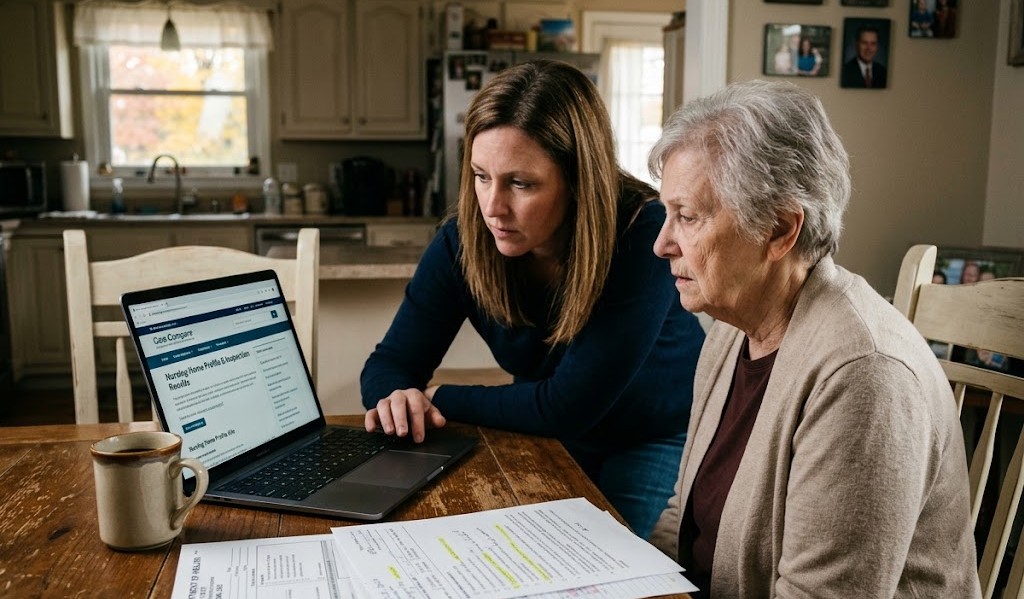
Choosing a nursing home for a parent or spouse is one of the hardest decisions a family makes, and it often has to be made within days of a hospital discharge. What many families do not realize is that every Medicare- or Medicaid-certified nursing home in Indiana is inspected regularly by the state, and the results are public. Most facilities receive at least some citations, so the useful question is generally not whether a nursing home has been cited, but for what, how seriously, and how often.
This article explains where that information lives, how to read it, and what it can and cannot tell you. It is written both for families comparing facilities before admission and for families who already suspect something is wrong and want to know whether the facility has a history of the same problem.
Who Inspects Indiana Nursing Homes
Nursing homes that accept Medicare or Medicaid must follow federal rules covering resident rights, freedom from abuse and neglect, pressure sore prevention, nutrition and hydration, medication management, infection control, and staffing. The federal government does not conduct most inspections itself. In Indiana, the Indiana Department of Health (IDOH), through its Division of Long-Term Care, performs them. Older documents may use the agency’s former name, the Indiana State Department of Health (ISDH).
IDOH conducts three main kinds of inspections, which regulators call “surveys.” A standard survey is an unannounced, comprehensive inspection. Federal rules require one no more than 15 months after the last, with a statewide average of about 12 months between surveys. A complaint investigation follows a report from a family member, employee, or anyone else; IDOH states that it investigates every complaint it receives. Facilities must also self-report certain incidents, including allegations of abuse and injuries of unknown origin, and some of those reports lead to on-site investigations.
When surveyors find a violation, they record it as a “deficiency” on a federal form called the CMS-2567, the Statement of Deficiencies. Each deficiency is tied to a specific rule, identified by an “F-tag” number, and receives a letter grade for seriousness. Those forms are the raw material behind every rating discussed below.
Step One: Look Up the Facility on Care Compare
The most complete free source for any certified Indiana nursing home is Care Compare, the federal website at medicare.gov/care-compare. It replaced the older “Nursing Home Compare” site in 2020. Search for nursing homes by name or ZIP code, confirm the street address, and then look beyond the stars:
- Health Inspection Results. This tab lists recent standard surveys and complaint investigations, how many deficiencies were cited on each, and whether any involved actual harm or immediate jeopardy. Each deficiency can be expanded, and the full inspection report can usually be downloaded.
- The Abuse Icon and Special Focus Status. CMS adds a red icon to a facility’s page when it was cited for abuse that harmed a resident on its most recent standard survey or a complaint survey in the past year, or for repeat lower-level abuse citations across consecutive surveys. A separate warning symbol marks facilities in the Special Focus Facility program, reserved for nursing homes with a persistent record of serious problems. Either symbol calls for a close reading of the underlying reports.
- Penalties. This section lists federal fines and payment denials, generally over the prior three years. A fine does not prove a particular resident was harmed, but repeated fines suggest problems the facility did not promptly correct.
- Staffing and Ownership. The staffing tab shows nurse hours per resident per day, weekend staffing, and staff turnover, drawn from payroll data the facility submits to CMS each quarter. Because chronic understaffing is one of the most common root causes of neglect, this data deserves as much attention as the inspection results. The firm has written separately about warning signs that a nursing home is understaffed. The ownership section shows who operates the facility and when ownership changed; a facility’s history does not reset when it changes hands.
Step Two: Understand What the Stars Measure
The five-star rating combines three parts: health inspections, staffing, and quality measures. CMS starts with the health inspection rating, then adds or subtracts a star based on the other two (CMS, 2026). The health inspection rating is the most important component, because it is the only one based on independent, on-site observation. Four things about the stars are worth knowing.
First, the stars are relative to other Indiana facilities. The top 10 percent of facilities in the state receive five stars and the bottom 20 percent receive one, so a three-star facility is “about average” for Indiana rather than good or bad in absolute terms. Second, the stars favor recent surveys. Since July 2025, the health inspection rating has been based on the two most recent standard surveys, with the newest weighted three times as heavily. Older surveys are still displayed on the page but no longer count, which means a facility with a long history of problems can look better than its full record suggests.
Third, the quality measures are largely self-reported. Ten of the fifteen measures come from assessments the nursing home itself completes for each resident (CMS, 2026), so these stars generally deserve less weight than inspection findings. Finally, the caps matter. A facility with an abuse icon has its health inspection rating capped at two stars but can still show an overall rating as high as four, and Special Focus Facilities receive no stars at all.
Step Three: Read the Deficiencies, Not Just the Counts
A facility with eight citations is not automatically worse than one with four. Every deficiency carries a letter from A through L that combines severity (how much harm occurred or could have) and scope (whether the problem was isolated, a pattern, or widespread). In plain terms, A–C means no actual harm and minimal risk; D–F means no actual harm but a real potential for it, with D being the most common rating; G–I means a resident was actually harmed; and J–L means immediate jeopardy, where the failure caused or was likely to cause serious injury or death. An isolated D-level deficiency counts for 4 points in the rating formula, while a widespread L-level citation counts for 150 (CMS, 2026). A single serious finding can matter more than a dozen minor ones.
The narrative portion of each deficiency is where families learn the most. Surveyors describe what they observed and what records showed, with residents identified only by number. The firm’s article on how to read the Indiana CMS 2567 deficiency report walks through the form section by section.
A few F-tags correspond directly to the failures that most often cause serious harm and are worth scanning for: F600 (abuse and neglect), F686 (pressure sores), F689 (falls, elopement, and supervision), F692 (nutrition and hydration), F725 (sufficient staffing), F760 (significant medication errors), and F880 (infection control).
Step Four: Check Indiana’s Own Records
IDOH publishes a Nursing Home Report Card that scores each facility on 45 care requirements across its last three standard surveys and compares it to the statewide average. It is a useful complement to the federal stars, especially for spotting whether a facility is improving or declining over time. IDOH’s Long Term Care Consumer Information page collects facility directories, complaint instructions, and other resources.
Two offline steps round out the research. Every Indiana nursing home is assigned a Long-Term Care Ombudsman, an independent resident advocate who generally knows which facilities draw frequent complaints; contact details are covered in the firm’s article on reporting nursing home abuse or neglect in Indiana. And federal rules require facilities to make their most recent survey results available on request. Asking to see them during a tour is routine, and how staff respond is itself informative.
What to Do With What You Find
For families choosing a facility, the record is most useful when weighed as a whole. Any immediate jeopardy or actual-harm citation in the past three years, an abuse icon, repeated citations under the same F-tag, high nurse turnover, or repeated fines generally warrant serious concern. A scattering of D-level citations for recordkeeping or building maintenance is common and does not by itself indicate poor care. Bring specific questions from the record to the tour, and keep checking the facility’s page every few months after admission, since new complaint investigations appear there whether or not the facility mentions them.
For families who already suspect neglect or abuse, the record helps answer a different question: was this an isolated event, or has the facility been cited before for the same failure? A prior citation for the same kind of problem, and the plan of correction the facility submitted in response, may be relevant to whether the facility knew of the risk. Referencing that history generally strengthens a complaint to IDOH or the ombudsman; the firm’s article on filing a nursing home complaint explains the process. In a civil claim, attorneys routinely review survey history, staffing data, and ownership records alongside the resident’s medical chart. Public records do not themselves prove that a particular resident was harmed, but they can reveal patterns and help frame requests for the facility’s internal records.
Families should also know that nursing home negligence claims in Indiana are generally governed by the Indiana Medical Malpractice Act, which typically requires review by a medical review panel and sets strict time limits, generally two years. Admission paperwork may also include an arbitration agreement. Because these rules are technical and the deadlines are firm, families who believe a loved one was seriously harmed may wish to seek legal guidance promptly rather than waiting.
Finally, inspection records capture only what surveyors saw during a limited window and what complainants reported. A clean history is encouraging but is not a guarantee of safe care. Regular visits at varying times remain one of the most effective ways to watch for the early signs of nursing home neglect.
Frequently Asked Questions
Q: Are nursing home inspection reports public in Indiana?
Yes. Survey results for certified facilities are posted on Care Compare and available from IDOH, and facilities must make their most recent results available on request.
Q: Can a facility with a good star rating still have serious violations?
Yes. Because older surveys and disputed citations do not count toward the current rating, and because staffing and quality measure stars can raise the overall score, a facility may show four stars while its page displays an abuse icon or a recent immediate jeopardy citation. Reading the inspection reports is the only way to know.
Q: Does a plan of correction mean the problem is fixed?
Not necessarily. It is the facility’s written promise to fix a deficiency. Surveyors generally return to verify the correction, but the plan itself is a commitment, not proof. Families can compare what was promised with what they observe.
Q: My loved one is in an assisted living facility. Can I look it up the same way?
Generally not. Care Compare covers only Medicare- and Medicaid-certified nursing homes. Indiana assisted living and residential care facilities are state-licensed, so their survey records are held by IDOH and can be requested from the agency or the facility.
Conclusion
A nursing home’s inspection history is one of the few objective sources of information available to families, and it is free and public. Used well, it helps families choose more carefully, ask sharper questions, and recognize when a problem fits a pattern the facility has been cited for before. Used carelessly, a star rating can create false confidence. The record is most valuable when families read the underlying reports, pay attention to staffing, and treat the public data as a starting point for their own observation rather than a substitute for it.
The Powless Law Firm is an Indiana law firm that represents victims and families state-wide in serious cases involving nursing home neglect, medical negligence, personal injury and wrongful death. If you have concerns about nursing home neglect or abuse, please contact us at 877-469-1292. Together we can make a difference.