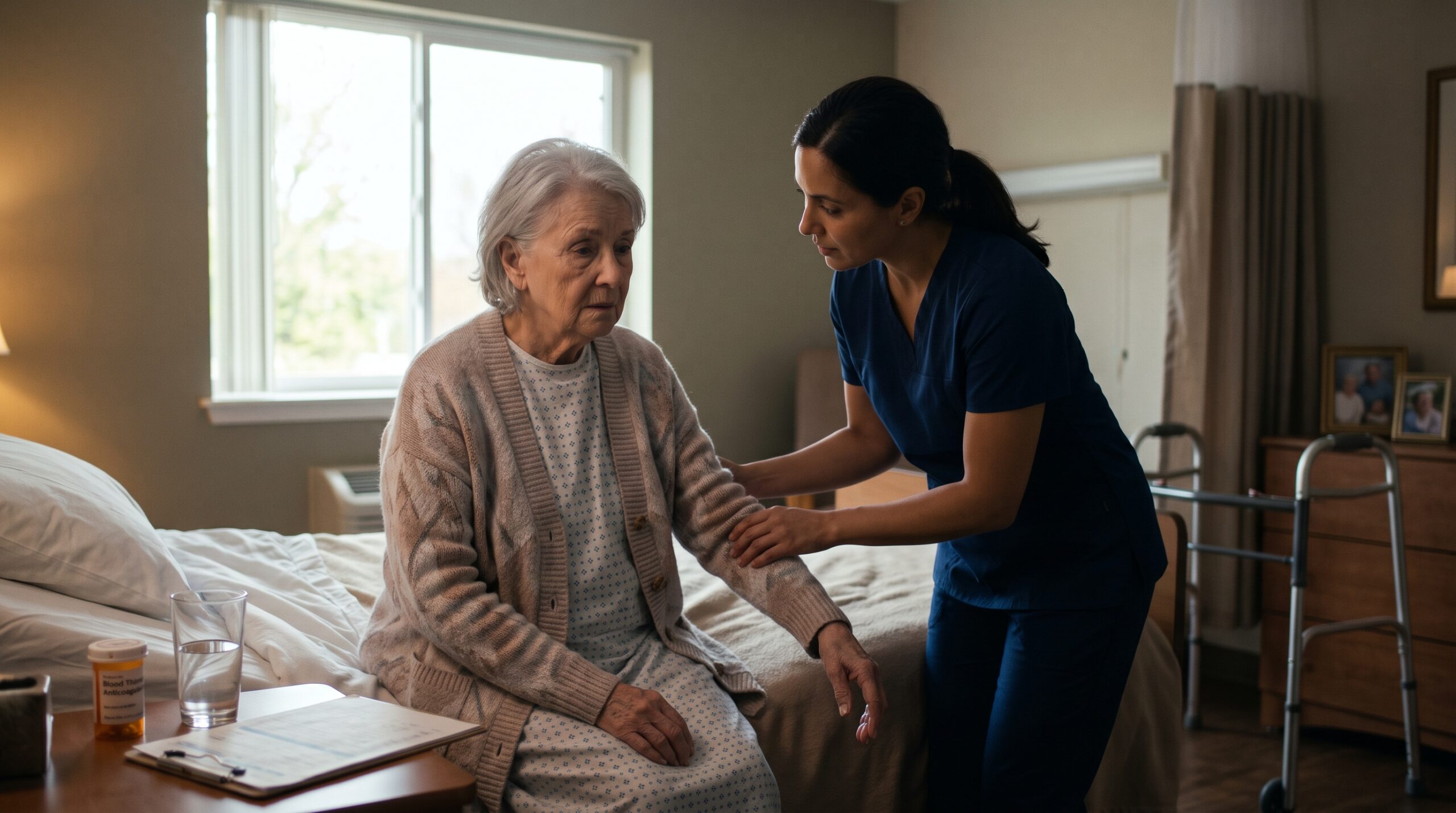
The call often comes without warning. A nurse says your mother “had a fall” or was “found on the floor,” but she seems fine and is resting comfortably. For many families, that sounds reassuring. But if your loved one takes a blood thinner, a fall that looks minor can be a medical emergency, and how the nursing home responds in the hours that follow can matter a great deal.
Blood thinners are commonly prescribed to older adults to help prevent strokes and blood clots. They also make it harder for the body to stop bleeding, including bleeding inside the skull that cannot be seen from the outside. This article explains why falls are especially dangerous for residents on these medications, what appropriate follow-up care generally looks like, and when a nursing home’s response may point to neglect.
Why Blood Thinners Turn a Routine Fall Into an Emergency
Anticoagulants such as apixaban (Eliquis), rivaroxaban (Xarelto), and warfarin (sometimes still called by its former brand name, Coumadin) slow the blood’s ability to clot. Some residents also take antiplatelet drugs like clopidogrel (Plavix) or daily aspirin, which also increase the risk of bleeding. These medications can be lifesaving, but they change what a fall can do to the body.
When an older adult on a blood thinner strikes their head, even a small tear in a blood vessel can keep bleeding. Blood can collect between the brain and the skull, a condition called a subdural hematoma, or bleed into the brain itself. As the blood builds up, it presses on the brain. Medical research recognizes long-term anticoagulation as an independent risk factor for both immediate and delayed bleeding inside the skull after head trauma.
The word “delayed” is important. A resident may look and act normal right after a fall, then begin to decline hours or days later. Medical literature describes delayed bleeding that can appear up to several weeks after the injury, though it usually shows up within the first 48 hours. That is why a resident who seems “fine” immediately after a fall still needs careful evaluation and close monitoring.
Age adds to the risk. As people get older, the brain naturally shrinks slightly, which stretches the small veins that bridge the brain and the skull. Those veins tear more easily, and an aging brain has more room for blood to pool before symptoms become obvious.
Unwitnessed Falls and the “Found on Floor” Note
Many nursing home falls happen when no staff member is present. A resident tries to get to the bathroom at night, slides out of a wheelchair, or stands up without the assistance their care plan requires. Staff later find them on the floor, and the chart records an “unwitnessed fall” or that the resident was “found on floor.”
An unwitnessed fall leaves a critical question unanswered: did the resident hit their head? Many residents have dementia or other cognitive impairments and cannot reliably describe what happened. Some cannot say whether they struck the bed rail, the nightstand, or the floor. They also may not be able to tell staff they have a headache.
For a resident on a blood thinner, a careful facility generally treats an unwitnessed fall as a possible head injury unless it can rule one out. A note that simply says “no apparent injury” may not be enough when no one saw the fall, the resident cannot explain it, and a brain bleed may not show outward signs at first.
How long the resident was on the floor also matters. A resident who went unchecked for hours may have been without the supervision their care plan called for, and lying on a hard surface can bring on additional problems such as dehydration and skin breakdown.
What Appropriate Post-Fall Care Generally Includes
Nursing homes that accept Medicare or Medicaid must follow federal regulations. One rule requires the facility to keep the resident environment as free of accident hazards as possible and to make sure each resident receives adequate supervision and assistance devices to prevent accidents (42 C.F.R. § 483.25(d)). Surveyors cite violations of this rule under federal tag F689.
A separate rule requires the facility to immediately inform the resident, consult with the resident’s physician, and notify the resident’s representative when an accident results in injury and has the potential to require physician intervention (42 C.F.R. § 483.10(g)(14)). For a resident on a blood thinner who may have hit their head, that standard is often met.
After a fall, appropriate care for a resident on anticoagulants generally includes:
- A prompt hands-on assessment by a licensed nurse before the resident is moved, checking for head strike, pain, deformity, and level of consciousness
- Timely notification of the physician, with the resident’s blood thinner clearly communicated
- Transfer to an emergency department for evaluation, often including a CT scan of the head, when a head injury is known or cannot be ruled out
- Scheduled neurological checks (alertness, pupils, speech, strength, and orientation) over the following hours and days, with each check documented
- Prompt notification of the family or resident representative
- A review of what caused the fall and an update to the resident’s care plan to help prevent the next one
Physicians’ practices for repeat imaging vary, and not every fall requires a hospital trip. But the decision whether to send a resident out should be made by a qualified clinician with the full picture, including the blood thinner and whether anyone saw the fall. It should not be made by staff who are not qualified to assess a possible head injury.
Delayed Warning Signs Families Should Watch For
Because bleeding inside the skull can develop slowly, families who visit after a fall may notice changes before staff do, especially if the resident’s baseline is well known to them. Warning signs of a possible brain bleed can include:
- New or unusual drowsiness, or difficulty waking
- Increased confusion, or a sudden change from the resident’s usual mental state
- Headache, or signs of head pain in a resident who cannot speak
- Nausea or vomiting
- Slurred speech or trouble finding words
- Weakness, numbness, or clumsiness on one side of the body
- Unequal pupils or new vision problems
- New trouble walking or loss of balance
- Seizures
In residents with dementia, these changes are sometimes dismissed as “sundowning” or the normal progression of their disease. A sudden change after a fall should not be assumed to be part of an existing condition. If you notice any of these signs, ask staff to contact the physician right away. If the change is sudden or severe, call 911.
When a Fall May Point to Neglect
Not every fall is caused by negligence. However, a nursing home is responsible for assessing each resident’s fall risk, putting reasonable safeguards in place, and responding appropriately when a fall happens. A resident on blood thinners is generally at higher risk of serious injury if they fall, and the facility should know that from the medication list.
Neglect may be involved before the fall when the facility:
- Did not assess the resident’s fall risk or update that assessment after earlier falls
- Did not follow the care plan, such as two-person assistance, a bed or chair alarm, a low bed, or regular toileting rounds
- Left the resident unsupervised despite known confusion or attempts to get up alone
- Was short-staffed, so call lights went unanswered for long periods
- Gave sedating medications that increased fall risk without appropriate monitoring
Neglect may also be involved after the fall when staff:
- Moved the resident or returned them to bed without a nursing assessment
- Did not notify the physician of the fall or of the resident’s blood thinner
- Did not send the resident for evaluation when a head injury could not be ruled out
- Skipped or did not document neurological checks
- Missed or ignored signs of decline in the hours or days afterward
- Delayed notifying the family, or gave an incomplete account of what happened
Delays in care can be especially harmful here. A brain bleed found early may be treated by reversing the blood thinner or with surgery. One found late may cause permanent brain injury or death. When a facility’s records show gaps, unanswered questions, or entries written long after the fall, it may be worth looking more closely at what happened.
What Families Can Do
If your loved one fell while taking a blood thinner, the first priority is their health. If they show any warning signs, insist that the physician be contacted and that they be evaluated. Once they are safe, a few steps can help you understand what happened.
Ask direct questions. Ask whether anyone saw the fall, when the resident was last checked before being found, whether the physician was told about the blood thinner, and whether a head CT was considered. Write down who you spoke with, the date and time, and what they told you.
Request the records. Under federal rules, a resident or their authorized representative generally has the right to inspect the resident’s records within 24 hours of a request (excluding weekends and holidays) and to get copies with two working days’ notice. Useful records include the incident report, nursing notes, neurological check sheets, the medication record, the fall risk assessment, and the care plan before and after the fall.
Document injuries. Bruises, cuts, and swelling can fade quickly. Photograph them with the date visible, and keep notes on changes in your loved one’s behavior. You may also want to read about whether a nursing home can stop you from taking injury photos.
Check the facility’s history. Past deficiencies for falls or supervision can be revealing. Our guide on how to check an Indiana nursing home’s inspection record walks through the process.
Consider filing a complaint. You can report concerns to the Indiana Department of Health, which investigates complaints against licensed nursing facilities. Learn more about filing a nursing home complaint and the Indiana nursing home complaint timeline.
Be aware of deadlines. In Indiana, claims involving health care, including many nursing home claims, generally must be filed within two years of the date of the alleged negligence. If the nursing home is a qualified provider under the Indiana Medical Malpractice Act, the claim generally must first be filed as a proposed complaint with the Indiana Department of Insurance and reviewed by a medical review panel before it can proceed in court. Because these rules can be complex, speaking with an attorney sooner rather than later can help protect your options.
Frequently Asked Questions
Does a nursing home have to send a resident to the hospital after a fall?
Not always. Federal rules require the facility to consult the resident’s physician when an accident causes injury that may need physician intervention. For a resident on a blood thinner who may have hit their head, many clinicians recommend emergency evaluation, often including a CT scan. Whether a transfer was needed depends on the specific facts, and a failure to involve the physician may be a sign of a larger problem.
My loved one seemed fine after the fall. Can a brain bleed still develop?
Yes. Bleeding inside the skull can develop slowly, particularly in people taking blood thinners. Symptoms often appear within the first day or two but can sometimes show up later. Watch for new confusion, drowsiness, headache, vomiting, or weakness, and report any change to staff and the physician.
What is an “unwitnessed fall”?
An unwitnessed fall is one that no staff member saw. The resident is typically found on the floor afterward. Because no one knows whether the resident hit their head, an unwitnessed fall in a resident on blood thinners generally calls for careful assessment and monitoring.
Is every nursing home fall a sign of neglect?
No. But a facility is responsible for assessing fall risk, following the resident’s care plan, providing adequate supervision, and responding appropriately after a fall. When those steps are missed, a fall may be connected to neglect.
How long do I have to take legal action in Indiana?
Indiana generally allows two years from the date of the alleged negligence to file a claim involving health care, including many nursing home claims. Exceptions and procedural requirements may apply, so it is wise to speak with an attorney promptly.
This article is for informational purposes only and is not legal or medical advice. Reading it does not create an attorney-client relationship. If you have questions about a specific situation, please consult an attorney.